trivago
Designing large-scale search experiences, improving how millions of travelers explore destinations through maps and location-based discovery.
Role
Product Designer
team
Search
scope
Location-Based Discovery & Design Systems
platforms
Desktop, Mobile Web, iOS & Android
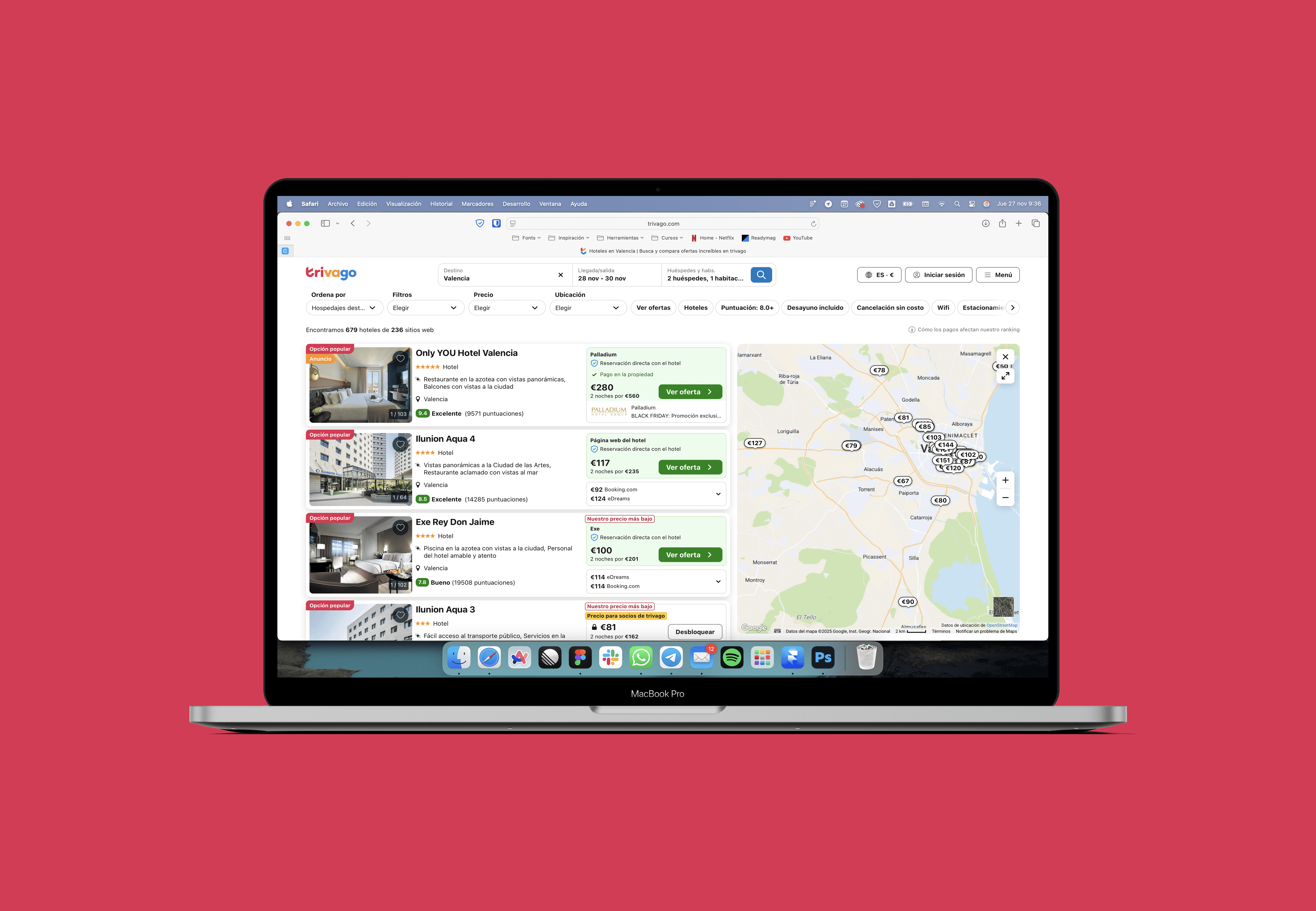
Trivago helps millions of travelers compare accommodation options across hundreds of booking platforms worldwide. With thousands of destinations, constantly changing inventory, and a wide range of user needs, search plays a critical role in helping people discover the right place to stay.
As part of the Search team, I worked on improving how users explore, evaluate and refine accommodation results across desktop and mobile experiences. My focus was primarily on location-based discovery, helping users navigate large sets of results through maps, filters and search tools while maintaining consistency across platforms.
Alongside feature work, I also contributed to the evolution of the design system, helping ensure that new experiences remained scalable, consistent and aligned across the broader product.
key contributions



Shaping map-based discovery
MAP FILTERS
Maps played a central role in how travelers explored accommodation options, yet refining results often required leaving the map and returning to separate filtering interfaces. This created friction in a journey that was inherently spatial.
opportunity
Rather than treating filtering and exploration as separate tasks, we explored how refinement could become a natural extension of map-based discovery, allowing travelers to narrow down results while maintaining geographic context.
solution
We explored lightweight filtering controls directly within the map experience, allowing travelers to refine results without leaving the spatial context of their search. Given the strong adoption of map-based interactions on desktop, the concept was initially developed and evaluated within the desktop experience, where it could have the greatest impact on user behaviour.
key considerations
Particular attention was given to maintaining visual clarity within a dense map environment and ensuring filtering remained lightweight enough to support exploration rather than interrupt it.
The exploration also raised broader questions about the role of maps within the search experience. While the initial concept focused on quick filters, it opened opportunities to investigate whether refinement, discovery and evaluation could happen directly within the map itself, challenging the traditional list-and-map model.


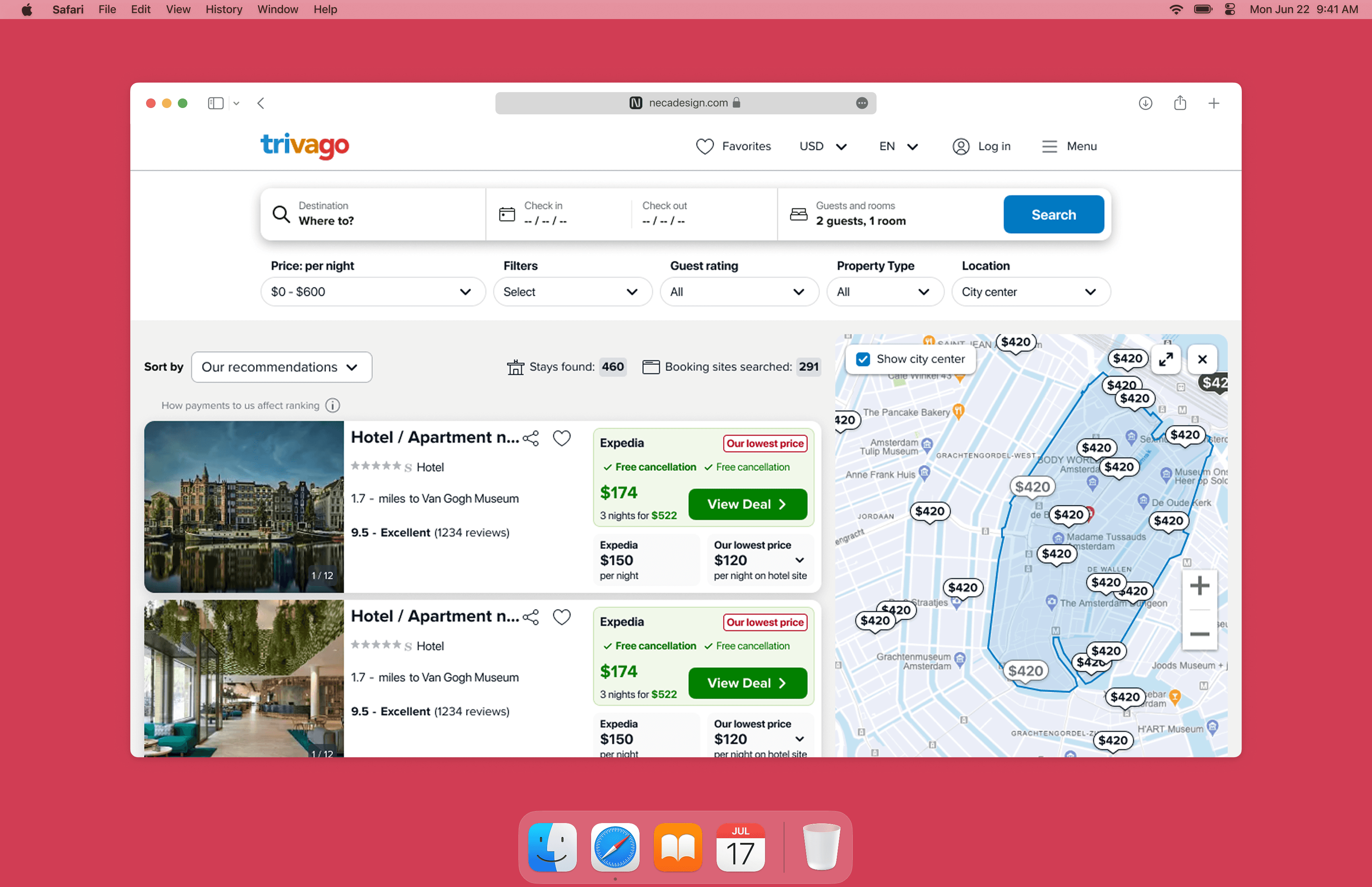
City center polygon
Many travelers use location filters to stay close to a destination’s main attractions. However, the concept of city center is far from universal. While it often represents the most desirable area in many European cities, expectations vary significantly across regions, making the filter difficult to interpret consistently.


opportunity
Rather than treating city center as a fixed geographical location, we explored how the experience could better communicate what the filter actually represented within each destination and help travelers make more informed location-based decisions.
solution
We introduced polygon-based boundaries that visualized the area associated with the city center directly on the map. The experience was complemented with contextual explanations through tooltips and educational banners, helping travelers understand that the highlighted area represented proximity to key points of interest rather than the literal geographical center of a city.
key considerations
A significant part of the work focused on discoverability and education. We explored multiple approaches for introducing the concept across desktop and mobile experiences, testing when information should appear, how long it should remain visible, and how users could revisit it without disrupting their search flow.
The project highlighted how seemingly simple filters often carry different meanings across markets, reinforcing the importance of balancing geographical accuracy, user expectations and contextual guidance within global travel products.
Alternative list
As travelers applied more filters or focused on highly specific locations, result sets often became increasingly limited. In some cases, users would reach a dead end where only a handful of accommodations remained, making it difficult to continue exploring alternative
opportunity
Rather than forcing travelers to manually broaden their search criteria, we explored how the experience could surface relevant alternatives while preserving the intent behind the original search.
solution
We introduced an Alternative List that surfaced nearby accommodations outside the user’s selected criteria, helping travelers discover additional options without having to restart their search. These results were visually differentiated from standard matches and connected directly to the map experience.
key considerations
A key challenge was maintaining trust and transparency. Users needed to understand why these accommodations were being shown and how they related to their active search criteria. We explored different ways of connecting alternative results to map interactions, balancing discoverability with clarity.
The project reframed constrained result sets as opportunities for continued exploration, highlighting how search experiences can remain helpful even when exact matches are limited.
Designing for Destination Uncertainty
destination cards
Not every travel journey begins with a destination in mind. Many travelers start with a broader intent, such as visiting a specific country, while still exploring where exactly to stay.
As part of Trivago’s wider discovery experience, we looked beyond accommodation search itself and explored how we could support travelers earlier in their decision-making process.
opportunity
We explored how destination discovery could become more actionable, helping travelers compare different areas within a country before committing to a specific destination or search.
solution
We introduced destination cards directly within the results experience, helping travelers explore specific destinations when searching at a country level. Each destination surfaced indicative accommodation pricing, allowing users to compare opportunities before committing to a particular location.
In split-view layouts, destinations were also represented on the map through interactive price markers. Hovering a destination card highlighted its corresponding location on the map, creating a stronger connection between list-based exploration and geographic context.
key considerations
To ensure consistency across the product, interaction patterns were aligned with existing search components. The hover behaviour was derived from established patterns already used within the search form, allowing the new experience to feel familiar while introducing a new layer of destination discovery.
Scaling consistency across platforms
DESIGN SYSTEM
While my primary focus was on discovery experiences, I also contributed to the evolution of the design system throughout my time on the Search team.
Much of this work involved improving how map and accommodation components behaved across desktop, mobile web, iOS and Android, helping ensure new experiences could scale consistently across platforms.
Component Architecture
Worked on the evolution of card and map components, reducing inconsistencies between experiences and creating reusable foundations for future discovery initiatives.
Responsive Behaviour
Defined how components adapted across desktop, mobile web and native platforms, balancing platform conventions with product consistency.
Scaling Discovery
Supported the implementation of new discovery experiences by extending existing system patterns rather than introducing isolated solutions, helping teams move faster while maintaining coherence across the product.
key learnings
Designing for millions of travelers across desktop, mobile web and native platforms taught me that even small decisions can have far-reaching consequences. A filter, a tooltip or a map interaction rarely exists in isolation; each decision affects multiple journeys, markets and devices simultaneously.
The experience reinforced the importance of systems thinking. Successful solutions weren’t defined by individual screens, but by how well they integrated into a broader ecosystem of behaviours, constraints and platform conventions.
Most importantly, I learned that good discovery experiences are not only about helping users find answers, but about helping them make decisions when the answer isn’t obvious yet.